


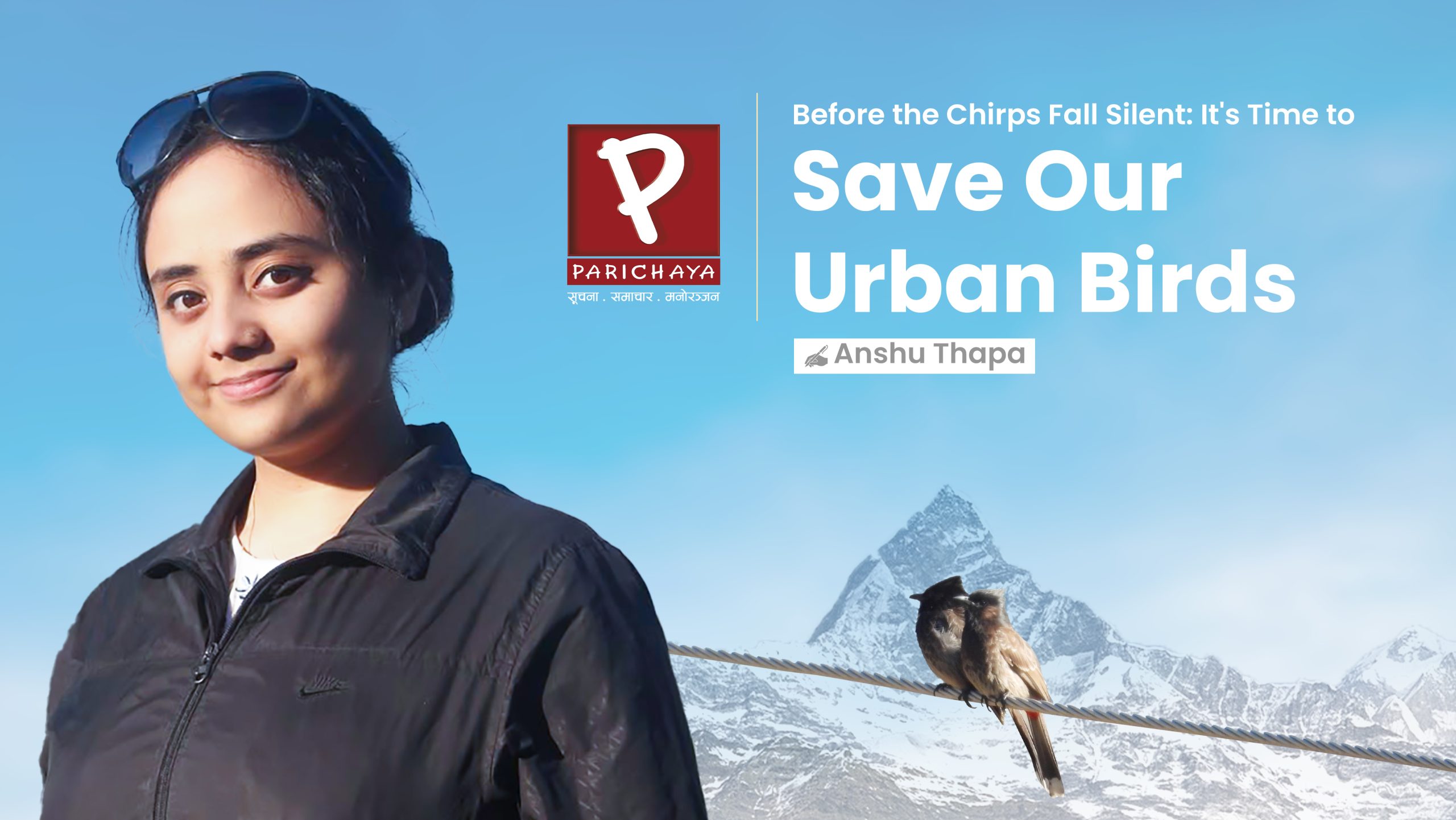
Anshu Thapa:
Do you ever take time to look around and let in the wonders of nature? It’s not really necessary to wait for holidays and venture to the mountains to experience nature at its finest. Take a deep breath, look around and you get to observe one of the wonders of wild simply fluttering around you every day. I’m referring to none other than our feathery neighborhood friends; the urban birds. These winged creatures play undeniably fundamental roles that contribute to the existence of the world we’re living in today. However, our reckless actions and negligence have pushed these captivating creatures to verge of extinction. Today, let’s dive into the wonders of avian world and acknowledge their contributions.
Birds are fascinating entities that nature uses to delicately construct network of connections among various aspects of ecosystem. They are found on almost every part of the world; different birds in different habitat types, ranging from marine oceans to alpine peaks and from evergreen forests to dry deserts. The urban birds are those which specifically thrive on human-dominated urban landscapes and inhabit almost every nook and cranny of cities. They reside in corners of buildings, rooftops, trees and even on electric poles. They significantly depend on us for food and shelter. In return, they control the functionality of the environment we live in, which ultimately contributes for existence of human civilization. The small actions they perform every day, which we often fail to notice, result in remarkable phenomena. Wonder how these little beings aid for regulation of the entire ecosystem? You’re on your way to find out!
Let’s begin with one of the main components supporting terrestrial life on Earth, the Plants. Research estimates that almost 175,000 species of plants, including more than 1,200 different crop species require pollination; a process through which fertilization occurs in plants resulting the production of fruits; and birds are known to be one of the excellent pollinators. It is found that at least 10,000 plant species rely on birds for pollination. Moreover, not only pollination, but birds play vital roles in seed dispersal as well. Frugivorous birds may take fruits miles away from its parent tree before consumption and then drop the seeds. Another scenario suggests that birds may even consume the fruit right on the parent tree, but still, the seed gets dumped somewhere else through birds’ excreta. Or, the seed might just get attached to bird’s body and get dropped somewhere while on flight. In conclusion, this phenomenon results dispersal of thousands of seeds in multiple places where new plants sprout and with time, develop as a forest ecosystem. In our rapidly urbanizing world, urban birds play key roles in maintenance of urban forests.
Urbanization often brings loads of pollution and waste. Birds being natural scavengers act as cleanup crew of the environment. Crows and starlings are often observed around trash bins and junk piles. They feed on organic wastes like kitchen leftovers, dead rodents, mosquitoes and food pieces, which if otherwise left untreated, would act as hub for bacterial growth, foul smell and multiple diseases. This ultimately creates much healthier and safer environment for us. Not only this, birds even prey upon the insects and pests thriving in agricultural fields, controlling the crop damages and playing significant part in food chain. Furthermore, research has found that the sweet bird chirpings and melodies can have positive impacts on our mental health. Unfortunately, these invaluable creatures are being continuously threatened due to various anthropogenic reasons. Wonder how we participate in this threat?
Let’s ask ourselves a simple question, where and how do we dispose chewing gums? Most people simply throw the gums on the ground without even wrapping. These gums attract birds as it appears as food, and it may stick on their beak or feathers making it hard for them to move or eat. Furthermore, the sharp objects like nails and glass pieces in the trash may severely injure the birds while searching for food. Another threat occurs from use of insecticides in our homes and in agricultural lands. When birds feed on poisoned insects, the toxin gradually accumulates in their body and ultimately results in death. Our smallest mistakes can be hazardous to entire bird population.

Modern cities are characterized by tall buildings with shiny glass walls and windows. This is where the next threat rises. Thousands of birds die each year due to window collisions. As the windows reflect the image of opposite surrounding, such as clear blue sky or trees, birds often get confused and strike right at the glass. Similarly, at night time, when the lights in a room are kept on, windows seem invisible. Light pollution not only boosts window collisions, but also attracts birds towards itself, acting as an ecological trap, and causes disruption during migration of many birds. Additionally, bird electrocutions due to high-voltage power lines is emerging as a serious issue in urban areas. This threatens not just the large endangered birds like vultures, but also the smaller and common birds like crows and pigeons. In Nepal, between 2010 and 2023, 122 vultures of 7 different species were reported dead due to electrocution, with 31 electrocutions recorded in 2022 alone. Again, research has identified sound pollution to be another threat, as it significantly increases stress hormones and anxiety, resulting in reduced body size and disrupted feather development in birds.
What’s more? None other than our dear pets, the cats and dogs. It’s their natural instinct to hunt and prey upon smaller animals like birds.
What can we do? These rollercoaster of threats can be controlled through small improvements in our habits. Proper wrapping and disposal of chewing gums, sharp objects and poisoned insects can alone aid to improve the scenario. Adding to this, keeping the unnecessary lights off, using thin lacy or patterned curtains on glass windows and using window stickers can help to reduce the collisions. Avoiding loud music/noise in open spaces and using the vehicle horns only when required can significantly reduce unwanted noise in an area. Moreover, establishment of power lines only after performing required EIA (Environmental Impact Assessment), and using bird repellents on the poles may help to reduce electrocutions.
Furthermore, simple acts such as providing food like grains and meat pieces (avoid bread and biscuits, as bread lacks sufficient nutrition and biscuits contain high sugar levels) and water to birds and promoting green spaces can significantly aid in improving urban habitats.
To conclude, birds are the protectors of the entire ecosystem. Their presence is a blessing bestowed to us. Threat to them is threat to entire life on earth. Our feathery friends have exceptionally performed their roles to safeguard this ecosystem. It is now our duty to protect and conserve these wondrous creatures.
“Let’s Unite Together to Conserve our Neighbor with Feather!”